
Union Minister Jyotiraditya Scindia on Tuesday pitched for policy guidelines to utilise scrapped vehicles as raw material for steel production, saying there are close to about one crore such vehicles in the country. Scindia, who also holds steel portfolio, said the time is not far away when the country will have to move towards green steel, and therefore, the option of iron ore and coking coal will not be available. Green steel is manufactured without using fossil fuels.

Delhi International Airport Limited (DIAL), which operates India's largest airport, dismissed the expert committee report as "inaccurate", claiming it relied on "probabilities, hypothesis, and conjectures" rather than empirical data or complete documentation.

The official said there are both challenges and opportunities for India as many of its competitor countries in exports, such as China Vietnam, Bangladesh, Cambodia and Thailand, face higher duties.

For the first time, the Data Security Council of India assembled a joint task force to source threat intelligence at the origin and ensure coordinated action across the cybersecurity spectrum.

The commerce ministry is working on different scenarios to assess the possible fallout of reciprocal tariffs to be imposed by the US administration on April 2 on its key trading partners including India, sources said. US President Donald Trump has said that April 2 will be 'Liberation Day' as he plans to announce tariffs or import duties to bring down America's trade deficit, and promote the country's manufacturing.

Here is a list of Q & As to explain these issues and implications of the US move.

The mission has proposed pilot projects for replacing fossil fuels and fossil fuel-based feedstocks with Green Hydrogen and its derivatives.

Four cities in neighbouring Pakistan and one in China are among the world's top 20 polluted cities.

Finance Minister Nirmala Sitharaman on Saturday said India is looking for a "good" trade agreement with the US to promote economic growth and ensure smooth supply chains. She also said that amid a growing global tariff war, India will have to move "smartly" to guard against possible dumping of goods from countries that are facing higher US tariffs.

Union Minister of Heavy Industries and Public Enterprises, H D Kumaraswamy on Saturday clarified that he was misquoted on his purported remarks regarding the United States semiconductor firm Micron.

India stares at the risk of an influx of Chinese products as US tariffs on a range of Chinese goods, including solar panels, electric vehicles, lithium-ion batteries, syringes, and steel, are set to take effect from September 27. With higher tariffs reducing China's access to the US market, there is concern that China may divert its exports to other markets, including India, which could lead to potential dumping of goods. This situation could challenge Indian industries, particularly in sectors where competition with Chinese products is already fierce.

The turnaround of SAIL from several quarters of losses was one of the most challenging experience, said Anil Kumar Chaudhary, the outgoing chairman of the country's largest steel maker. The chairman said he also wants to see SAIL paying back at least 50 per cent of its debt in the near future. Chaudhary who had joined SAIL as a junior manager in 1984 would be superannuating from the top post on December 31, 2020 after serving the company for almost 36 years in various roles.
India and the United States will finalize the contours, schedule of negotiations, and terms of reference for a proposed bilateral trade agreement (BTA) during a three-day meeting beginning Tuesday. The agreement is expected to be finalized in two tranches, with the first phase focusing on goods trade. The US team, led by Assistant US Trade Representative for South and Central Asia Brendan Lynch, will be in India from March 25-29 to discuss the agreement. Both countries are aiming to conclude the first phase of the agreement by fall 2025.

Forty-five specialists will soon be joining key posts of joint secretaries, directors and deputy secretaries in different central ministries as part of the Modi government's ambitious plan to infuse fresh talent to further improve ease of governance.

During a cabinet meeting earlier in the day, Modi lauded both Naqvi and Singh for their contributions to the country during their ministerial tenure, sources said.

'The BJP's numbers in this government are almost the same as those enjoyed by the Congress under P V Narasimha Rao when the reform process was kicked off in 1991.' 'As before, the only constraints on the prime minister's actions are internal, not external.' 'They come from his own assessment of the political consequences of any action,' points out Mihir S Sharma.

Dr T V Somanathan is the first finance secretary to be appointed Cabinet secretary since 1985. His appointment at this juncture seems to carry much meaning for the forthcoming trajectory of reforms and restructuring of India's steel frame.

He said this in response to a query during a press interaction held at his residence in New Delhi on what Germany was willing to do bring over three-year-old Ariha back and whether her issue will be raised at the "highest level".

The monthly Rs 2500 payment for poor women is expected to cost Rs 11,000 crore while the pension scheme of Rs 2000 for every senior citizen will cost around Rs 4100 crore. The Yamuna clean up will cost over Rs 10,000 crore while a similar amount is required to upgrade Delhi's hospitals. Ultimately, the new BJP government will have no choice but to ask the centre for financial support, notes Rashme Sehgal.

The new guidelines, effective from August 1, aim to expedite visa approvals for nationals from China and other countries sharing land borders with India.
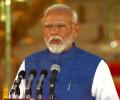
Here is the complete list of ministers in Modi 3.0 and their portfolios:
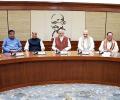
Among the new entrants to the Union cabinet, former Madhya Pradesh chief minister Shivraj Singh Chouhan has been given the agriculture and rural development portfolios, Bharatiya Janata Party president J P Nadda the health portfolio and former Haryana chief minister Manohar Lal Khattar the power portfolio.

A day after facing massive erosion from their wealth, equity investors became richer by Rs 13.22 lakh crore on Wednesday with markets making a strong comeback. The 30-share BSE Sensex jumped 2,303.19 points, or 3.20 per cent, to settle at 74,382.24. During the day, it rallied 2,455.77 points, or 3.40 per cent, to 74,534.82.
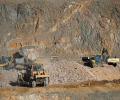
India is planning to soon sign new and updated mineral pacts with about a dozen countries in Africa. The Ministry of Mines is in discussions with Cte d'Ivoire, Democratic Republic of the Congo (DRC), Madagascar, Malawi, Mali, Morocco, Mozambique, South Africa, Tanzania, Zambia and Zimbabwe, Business Standard has learnt. Negotiations are ongoing with around a dozen countries, and more will be added to the list soon.

The Supreme Court verdict on mining royalty case will give a further jolt to the Indian mining industry and will have very large financial implications, as arrears may work out to the tune of more than Rs 1.5 lakh crore to Rs 2 lakh crore, industry players said on Wednesday. The Supreme Court on Wednesday upheld the power of states to levy tax on mineral rights and mineral-bearing land, and allowed them to seek refund of royalty from April 1, 2005 onwards. According to a senior mines ministry official, the verdict will have a very large financial impact on mining, steel, power and coal companies.

The minister said to protect the interest of domestic steel producers appropriate fiscal measures to curb the threat of cheap steel import and dumping should be taken soon.

The Centre has taken a major step towards increasing efficiency in decision-making by empowering joint secretaries to report to secretaries directly, officials said on Wednesday.

The government is expediting visa-related issues to bring technicians to India from any country, not just China, as and when required, to ensure the smooth implementation of the flagship production-linked incentive (PLI) scheme aimed at boosting domestic manufacturing. "If those under the PLI scheme need to get their equipment installed, we try to expedite the ability to get technicians into India from any country, whichever it may be," Union Commerce and Industry Minister Piyush Goyal told Business Standard in an interview.
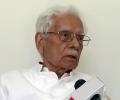
Because of his proximity to Indira Gandhi, he was able to intervene directly at the level of the PMO, which he did in the days leading up to the partition of Pakistan in 1971 when he transferred crucial information about Pakistan's moves via information handed to him by an East Pakistani diplomat in Poland where he was posted.

From the Sensex basket, Power Grid, Asian Paints, Tata Motors, Tata Steel, NTPC, Sun Pharma, Mahindra & Mahindra, HDFC Bank, Tata Consultancy Services and JSW Steel were among the major gainers. Kotak Mahindra Bank, Bharti Airtel, Axis Bank, Wipro, ICICI Bank and IndusInd Bank were among the laggards.

Bharatiya Janata Party's National Democratic Alliance partners have got five cabinet ministerial berths in the third term of Prime Minister Narendra Modi, as against none in the outgoing government, given the party's dependence on allies for a majority in the Lok Sabha.

'I think some of us, like Mukesh Ambani, myself and those of us who head industrial units, ought to really focus on what we can really do to make the world a safer place, maybe 50 or 100 years from now.' 'For instance, how can we deal with climate change and global warming, right now?' 'The effects of it may not be felt now; in fact, we may pay a price for it today, but it will help the generations to follow.'

The Coal Ministry has issued show-cause to eight firms including Hindalco Industries and Mahanadi Coalfields, and sought explanation from five firms for delays in commencing production from mines allocated to them.

Shiv Sena-Uddhav Balasaheb Thackeray leader Priyanka Chaturvedi on Wednesday took potshots at the rival Shiv Sena over its minister not finding a place in the reconstituted NITI Aayog.

Moody's Ratings on Tuesday said India's growing water shortage can disrupt farm and industry sectors and is detrimental to the credit health of the sovereign as rising food inflation and decline in income may spark social unrest. It said decreases in water supply can disrupt agricultural production and industrial operations, resulting in inflation in food prices and hence can be detrimental to credit health of sectors that heavily consume water, such as coal power generators and steel-makers.

The strong message from the prime minister is of continuity of policies he considers right with strong emphasis on execution, points out T N C Rajagopalan.
Token rollback will only help middlemen, complain large producers.

Ratan was extremely ethical in his dealings, which he brought to bear on the business house which he helmed, remembers Sailesh Kottary.
